
The tree outside our window is nearly bare.
Way too soon, I think.
I check the date.
No. The time is right.
I don’t want to watch more leaves fall.
I’ve lost my grip on time, probably from holding on to it so tightly.
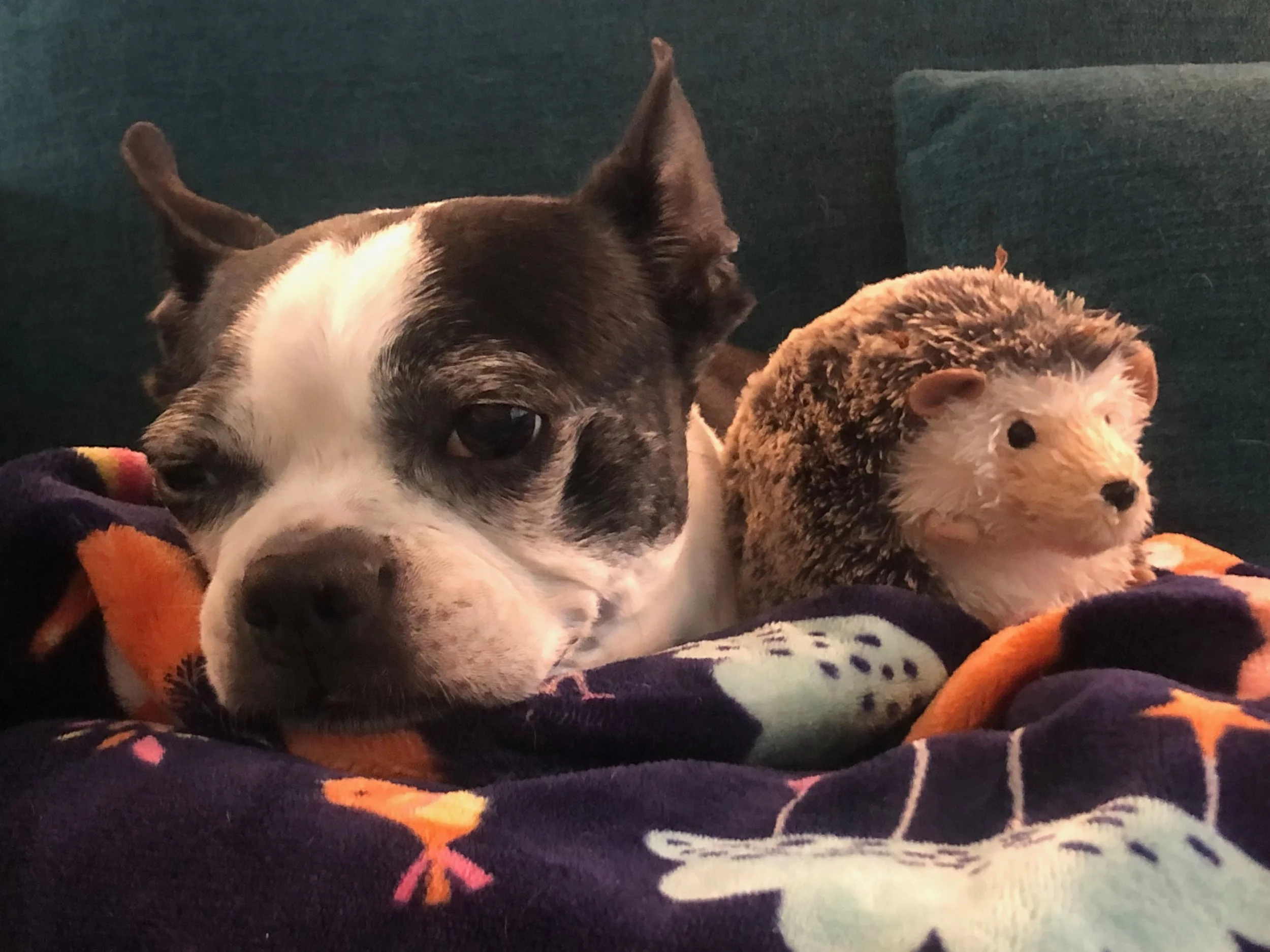
I’m convinced our Lilly, the Boston terrier, has at least another year in her—that tough little bird. As a pup, she competed for scraps in a home that didn’t love her. With diligent training, she conquered so much of her fear-aggression toward other dogs. Last year, she kicked cancer’s ass—twice.
My wife sees the signs weeks before I can acknowledge their severity. Isolating in a dark room for hours, staring into the void. Turning down most invitations to play. The shrill barking and pacing that neither medication nor gentle rocking could soothe.
I’m not convinced Lilly’s “time” is coming. I meet my wife’s broaching of Lilly’s “quality of life” with dismissive huffs or “What are you implying!?”
Our girl’s not dying! She’s not sick!
Then comes the vet visit, during which she trembles violently. Lilly is diagnosed with severe periodontal disease. My diligent finger-brushing had prevented nothing. “Lilly is likely in severe pain.” Ah! There’s the cause of her behavior! Let’s fix it!
We schedule oral surgery. Could be invasive. She’d had rocky recoveries from anesthesia before. But my wife and I nod. Worth the risk to clear the infection and give her renewed life.
But what kind of life?
In the coming days, my wife reconsiders. Radical surgery? To what end? To squeeze out more time of questionable quality? Humane euthanasia is the only answer.
I protest. Euthanasia is for animals with terminal illnesses who are in intractable pain. Not for animals “showing signs” of decline that could take months, even a year or more, to claim them.
Really? Why would I want to wait until Lilly’s decline accelerated before I put an end to it?
My wife prints out Lap of Love’s Quality of Life Scale. We both complete the questionnaire. Separately. I, perhaps a bit less honestly than my wife. We both score Lilly in the bottom tier for quality of life. Barely. We meet with a hospice veterinarian. The truth is undeniable: she’s not enjoying so many of the things she once loved to do.
Still, I cling to reasons to choose life. The sweet sniffing exchange between her and a neighbor’s dog. Lilly bringing her stuffed frog to my wife for a brief game of tug. See that! It’s not time!
I hang myself on the tenterhook of hope to reverse the irreversible. One thought unhooked me: Perhaps Lilly’s small bursts of energy are her way of saying, “Thanks for my wonderful life.”
Lilly’s time is coming. Between now and then, we’ll love on her like there’s no tomorrow, same as we have for the past 13+ years since we adopted her at nine months. Tomorrow, she will draw her last breath, ensconced in love, her favorite toys, and her blankie. We’ll sing to her, cry, and pray for ways to move gently into her absence.
We hope she can hear. That she knows how much we loved her. How much I hate any suggestion of a heaven without her.
Life will go on after the warm handoff at the Compassionate Care’s Aquamation Center. We’ll eventually go shopping. Gas up the car. Offer a protein bar to a homeless person. Practice small kindnesses everywhere—because we don’t know what losses others carry.
We’ll return to our empty home—no nails skittering across the floor to greet us. Then I’ll remember; it’s been many months since Lilly’s done that.
I will stare outside our window at the tree’s bare limbs, grateful for the leaves that once filled its canopy. And the leaves that will sprout again next spring.